Mountaineer Casino Racetrack Betting Guide
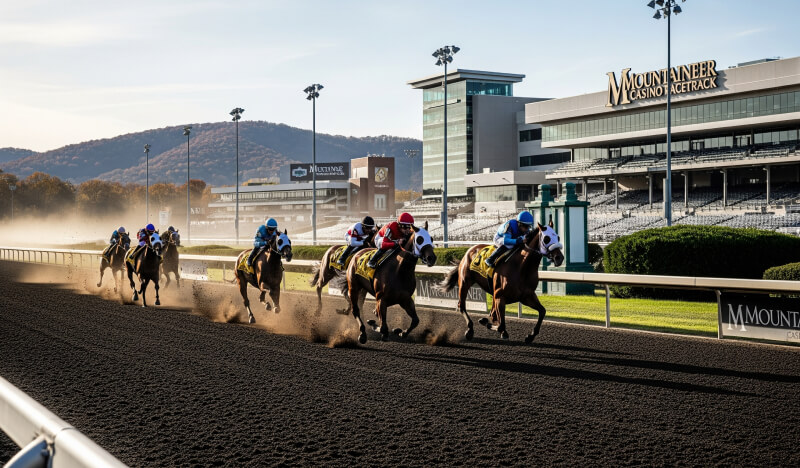
The single most important thing to know: Mountaineer is a dirt track, not synthetic. The one-mile oval with a curved front stretch and a short 905-foot homestretch heavily rewards early speed and inside position. This is a night racing circuit running almost exclusively at 7:00 PM from April through December, dominated by a small colony of trainers and jockeys who win at rates the public consistently underestimates. If you know who to back - and when the late-season horse influx creates soft spots - this track prints money.
The Quick Version
Surface: Dirt, one-mile oval (plus a 7-furlong turf course used in summer months) Track favors: Early speed and inside posts - the curved front stretch and short homestretch make it difficult to close from behind Key trainers: Jose Luna Silva (86 wins, 23%), Anthony Farrior (28 wins, 35%), Jeff Fletcher (21 wins, 36%), Eric R. Reed (23 wins, 25%) Key jockeys: Luis Negron (97 wins, 20%), Brandon Whitacre (76 wins, 22%), Deshawn L. Parker (47 wins, 25%), Erik Barbaran (47 wins, 20%) Season: April through December, 7:00 PM post time (night racing) Best bet type: Exactas keying dominant jockey-trainer combos over the field
Post Position Breakdown
Mountaineer's one-mile dirt oval with a curved front stretch creates a structural inside bias. The 905-foot stretch run is short by industry standards - compare that to Churchill Downs at 1,234 feet or Fair Grounds at 1,346 feet. Closers simply don't have enough real estate to make up ground.
Dirt Sprints (5.5-6.5 Furlongs)
| Post | Outlook | Notes |
|---|---|---|
| 1-3 | Strongest | Clean break to the rail on a curved stretch gives early positioning advantage |
| 4-6 | Viable | Need tactical speed to stay in contention through tight turns |
| 7+ | Disadvantaged | Wide trips are costly on a one-mile oval with sharp turns |
Dirt Routes (1 Mile+)
| Post | Outlook | Notes |
|---|---|---|
| 1-3 | Best | Two-turn routes amplify the inside edge |
| 4-6 | Playable | Needs pace scenario help or strong class edge |
| 7+ | Pass | Too much ground to lose on tight turns, too little stretch to make it up |
The edge: The 905-foot stretch at Mountaineer is among the shortest in the country for a one-mile oval. For context, Santa Anita's stretch is 990 feet and even that favors speed. At Mountaineer, the rail is golden. Build your tickets around horses who can secure inside position early.
Track Bias Reality Check
The Curved Front Stretch Factor
This is what makes Mountaineer different from most one-mile ovals. The front stretch isn't straight - it has a slight curve. That creates two problems for closers: they burn extra energy navigating the curve on the run to the finish, and it compresses the effective length of the stretch run even further. Speed horses on the lead barely feel it because they're already on the rail.
Running Style Impact
| Style | Sprint Outlook | Route Outlook |
|---|---|---|
| Front runners | Strong | Strong |
| Pressers | Best | Strong |
| Stalkers | Viable | Viable with pace meltdown |
| Deep closers | Tough | Very tough |
The edge: On a track with tight turns, a curved front stretch, and a short homestretch, tactical speed is king. The ideal horse at Mountaineer breaks cleanly, sits just off the pace within striking distance, and kicks past tired leaders in the final sixteenth. True deep closers need a pace meltdown to have any chance - don't bet them expecting miracles.
Dirt vs. Turf
Mountaineer's 7-furlong turf course runs inside the dirt oval during summer months. Turf racing adds a different dynamic - it opens up opportunities for stalkers and closers that don't exist on the dirt. When turf cards are available (roughly May through October), they're worth playing differently from the dirt.
Turf edge: The 7-furlong turf course is tight, and post position matters even more. Inside posts are critical. When turf races get washed off to dirt, horses drawn wide who were counting on turf stalking tactics are at a major disadvantage.
Trainer Angles
2025 Season Final Standings (April 20 - December 9)
| Trainer | Wins | Starts | Win % | Earnings | Notes |
|---|---|---|---|---|---|
| Jose Luna Silva | 86 | 376 | 23% | $847,884 | Dominant volume - 32 more wins than #2 |
| Eddie Clouston | 54 | 321 | 17% | $572,405 | Consistent second, high volume |
| Jay P. Bernardini | 52 | 260 | 20% | $607,388 | Strong earnings per start |
| Juan C. Vazquez | 32 | 151 | 21% | $337,609 | Good rate on fewer starts |
| Jami C. Poole | 28 | 215 | 13% | $362,968 | HBPA president, steady runner |
| Anthony Farrior | 28 | 81 | 35% | $273,571 | Elite strike rate, lower volume |
| Denis Cluley | 25 | 132 | 19% | $290,872 | Consistent |
| Eric R. Reed | 23 | 93 | 25% | $291,783 | Kentucky Derby-winning trainer (Rich Strike, 2022) |
| Jeff Fletcher | 21 | 59 | 36% | $206,756 | Highest win rate among leaders |
| Tina Ramgeet | 17 | 139 | 12% | $219,744 | Husband Andrew Ramgeet rides her stock |
Trainer Betting Angles
-
Jose Luna Silva is the undisputed king of the Mountaineer meet. His 86-win season from 376 starters means he fires in nearly every race. The key: his win rate is 23%, which means he's live more often than his prices suggest. When he pairs with Luis Negron (his go-to jockey), that combo is the most powerful at the track.
-
Anthony Farrior at 35% from 81 starts is the stat that should make you sit up. He's selective - only 81 starters vs. Silva's 376 - which means when he enters, he means it. Often paired with Marshall Mendez.
-
Jeff Fletcher is even more selective (59 starts) at an incredible 36% win rate. This is a trainer who doesn't waste entries. Back him when he runs.
-
Eric R. Reed is a name the public knows from Rich Strike's 2022 Kentucky Derby upset at 80-1. He runs a satellite operation at Mountaineer alongside bases at Belterra Park, Presque Isle, and his Mercury Training Center in Lexington. His 25% strike rate at Mountaineer means his runners are always live - and he sometimes gets overlooked because bettors associate him with bigger tracks.
The edge: At a track dominated by a small training colony, the win percentages are real and repeatable. Silva, Farrior, Fletcher, and Reed win at rates that the public doesn't fully respect in the betting pools. When these trainers scratch down to short fields, their runners are often near-certainties.
Jockey Angles
2025 Season Final Standings (April 20 - December 9)
| Jockey | Wins | Starts | Win % | Earnings | Notes |
|---|---|---|---|---|---|
| Luis Negron | 97 | 485 | 20% | $1,001,659 | Dominant leading rider, only jockey over $1M in earnings |
| Brandon Whitacre | 76 | 342 | 22% | $773,526 | Best win rate among top volume riders |
| Kevin Gonzalez | 64 | 524 | 12% | $777,144 | Most mounts, but lower win rate - value on longshots |
| Ricardo Barrios | 48 | 411 | 12% | $620,914 | Volume rider |
| Erik Barbaran | 47 | 233 | 20% | $520,385 | Strong rate on moderate volume |
| Charle Oliveros | 47 | 320 | 15% | $571,714 | Consistent |
| Deshawn L. Parker | 47 | 186 | 25% | $444,901 | Mountaineer's all-time leading rider, former king of the track |
| Bailey Weatherly | 46 | 386 | 12% | $574,536 | High volume, lower rate |
| Michael Y. Pagan | 40 | 237 | 17% | $437,765 | Solid mid-tier |
| Brandon Tapara | 35 | 239 | 15% | $437,501 | Consistent |
Jockey Betting Angles
-
Luis Negron is to Mountaineer what Irad Ortiz Jr. is to Gulfstream - the guy who gets the best mounts and delivers. His 97 wins and 20% rate mean he's live in nearly every race. The catch: his horses are often bet down to short prices. The real value is using him as a key in exotic bets.
-
Deshawn L. Parker is a living legend at Mountaineer. At 5'11", he's one of the tallest jockeys in the game and a George Woolf Memorial Award winner. He's Mountaineer's all-time leading rider with nearly 6,000 career wins. His 25% win rate in 2025 on just 186 mounts means he's incredibly selective about which mounts he takes. When Parker rides, he thinks he can win.
-
Brandon Whitacre at 22% from 342 mounts is the value play. He gets strong horses from Jay Bernardini's barn and other top outfits, but isn't bet as heavily as Negron.
-
Erik Barbaran at 20% from 233 mounts is another solid pick - not overbet, gets quality stock.
The edge: The Negron-Silva combo is the most powerful jockey-trainer pairing at Mountaineer. But because it's so well known, the value often lies with Whitacre (22%) and Parker (25%), who deliver at high rates without being the automatic public choice.
The West Virginia Racing Circuit
Mountaineer and Charles Town: Two Tracks, One Ecosystem
West Virginia's two thoroughbred tracks - Mountaineer in the northern panhandle and Hollywood Casino at Charles Town Races in the eastern panhandle - form a connected racing ecosystem. Understanding how horses, trainers, and jockeys move between them is a genuine edge.
Key differences:
- Mountaineer: Night racing (7 PM), April-December, ~125 dates, claiming-focused with the Grade 3 West Virginia Derby as the marquee event
- Charles Town: Year-round racing, ~165 dates, higher handle, the Charles Town Classic is the big race
The shipping angle: When Mountaineer's season ends in December, many horsemen have nowhere to go. As HBPA president Jami Poole noted, "90% of these horsemen here, when we close here, have nowhere to go." This creates a unique dynamic:
- Late-season Mountaineer form is valuable for early-season Charles Town plays
- Horses that have been training through the Mountaineer meet are fit and ready when other tracks' horses are just getting started in spring
The late-season influx: Starting in October-November, Mountaineer sees a "massive uptick" in horse population as tracks like Presque Isle Downs (PA), Belterra Park (OH), and Fort Erie (Canada) close for the year. This creates larger fields, more competitive racing, and better opportunities for bettors who handicap the newcomers properly. In October 2025, Mountaineer's fields jumped from match races to 10-12 horse fields once this influx hit.
The edge: Horses shipping in from closing tracks often need a start or two to adjust to Mountaineer's dirt surface and tight turns. Their first start is often a throwaway - but their second or third start, once they've adapted, is where the value lies. Meanwhile, established Mountaineer horses who've been running all season have a clear fitness and track-familiarity edge.
Weather & Surface Patterns
Night Racing and Temperature
Mountaineer runs almost exclusively at night. The 7:00 PM post time means races happen as temperatures drop, which affects the dirt surface differently than daytime racing:
- Spring (April-May): Cool evenings can make the dirt surface firm and fast. Speed holds better when the track doesn't bake all day.
- Summer (June-August): Humid Ohio River valley air keeps the dirt surface holding moisture later into the evening. Track can play "dead" on hot, muggy nights.
- Fall (September-November): Best racing conditions. Cooler air, less humidity, faster track.
- Late season (December): Cold nights create firm, sometimes frozen conditions. The track becomes unpredictable.
Ohio River Effect
Mountaineer sits right along the Ohio River, which creates fog and humidity patterns unique to the area. River fog can delay cards, and the moisture from the river valley keeps the track from drying out as quickly as inland tracks.
Sloppy Track Days
When rain hits Mountaineer's dirt track, races scheduled for turf get moved to the main track. These surface switches catch bettors off guard:
- Turf-intended horses forced onto sloppy dirt are usually worth fading
- Speed horses gain an even bigger edge on off tracks, as the kickback factor discourages closers further
- Watch for when rain cancels turf cards - the horses originally entered for turf are often misplaced on dirt
The edge: Track condition matters more at night racing venues. The dirt doesn't get the daytime baking that drives moisture off at day tracks. Mountaineer's dirt can ride differently from card to card based on weather patterns rolling through the Ohio River valley. Check the weather before you bet.
The Betting Playbook
When to Bet Aggressively
- Jose Luna Silva + Luis Negron combo in sprints: The most powerful trainer-jockey pairing at the track. When they team up with an inside post, that's your best play.
- Anthony Farrior's entries (35% win rate): He's selective. When he enters, he expects to win.
- Jeff Fletcher runners (36% win rate): Same logic - tiny barn, high strike rate, live every time.
- Deshawn Parker pickups (25%): When Parker accepts a mount, he thinks it can win. His selectivity is your signal.
- Brandon Whitacre on Jay Bernardini trainees: The second-most-dangerous jockey-trainer combo at the track. Both hitting at 20%+.
- Late-season Mountaineer regulars vs. new shippers: In October-November, established runners have the fitness and track-knowledge edge over newcomers from closing tracks.
- Inside posts in sprints: The curved front stretch + short homestretch = inside speed wins.
When to Stay Small or Pass
- Deep closers in dirt sprints: The 905-foot stretch and curved front stretch kill late runners.
- Wide posts (8+) in routes: Two tight turns on a one-mile oval mean wide trips are expensive.
- First-time shippers from closing tracks: Horses making their first start at Mountaineer after shipping in from Presque Isle, Belterra, or Fort Erie often need a race to adjust.
- Kevin Gonzalez at short prices: 524 mounts but only 12% win rate. He rides everything, so short prices on his mounts are usually overbet.
- Turf-to-dirt scratches: When turf races get washed off, horses entered for turf rarely fire on dirt at value.
- Match races and 3-horse fields: They happen here, especially early and late season. Small fields are unpredictable and the takeout eats into thin margins.
Best Bet Types at This Track
Exactas: This is the Mountaineer sweet spot. Key the top jockey-trainer combos on top and spread underneath. With a small jockey colony, the same riders finish 1-2 repeatedly.
Pick 3s: Chain together dirt races keying Negron, Whitacre, and Parker. The jockey concentration makes Pick 3s more predictable than at larger tracks.
Win betting: Viable on high-percentage trainers like Farrior (35%) and Fletcher (36%) when their runners are value-priced.
Daily Doubles: Connect early races (where the favorites are more predictable) with later races where you can spread.
What to avoid: Superfectas in small fields (common here) and Pick 4/Pick 5 sequences that include turf races - surface switches can wreck your ticket.
Seasonal Patterns
Opening Meet (April-May)
- Surface: Dirt often firm and fast after winter maintenance
- Fields: Smaller as the horse population builds
- Strategy: Trust returning Mountaineer veterans over new arrivals. The colony trainers (Silva, Clouston, Bernardini) have their stock ready
- Watch for: Horses shipping from Charles Town's winter season
Summer / Turf Season (June-August)
- Surface: Turf course opens, adding variety to cards. Dirt can ride heavy in humidity
- Fields: Largest of the year, especially on West Virginia Derby weekend
- Strategy: Turf races play differently - stalkers and closers get a chance they don't get on dirt
- Key date: West Virginia Derby day (first Saturday in August) is the only afternoon card of the season
West Virginia Derby Day (August)
- The race: Grade 3, 1 1/8 miles on dirt, $400,000 purse (2025)
- 2025 Winner: Chunk of Gold (Ethan West / Jareth Loveberry) - 1:50.97
- 2024 Winner: Dragoon Guard (Brad Cox / Florent Geroux) - gate-to-wire, 1:49.96
- Trend: Big-name shippers (Asmussen, Cox, Baffert) have dominated this race historically. Steve Asmussen has won it 6 times. Don't expect the local colony to compete at this level.
- Strategy: Trust national trainers in the Derby itself. Play the undercard with local colony angles.
Late Season Influx (October-December)
- Surface: Cooling temperatures, fast dirt
- Fields: Largest of the meet as horses pour in from Presque Isle, Belterra, Fort Erie
- Strategy: This is when the best betting opportunities exist. Larger fields mean better odds, and shippers need adjustment time. Key Mountaineer regulars against newcomers in their first local start.
- 2025 season close: December 9 (extended from December 3 due to high horse population)
- 2026 season start: April 12
Get today's selections: View Mountaineer tips
Sources: Equibase • Wikipedia • Off Track Betting • Thoroughbred Daily News • BloodHorse • America's Best Racing • Paulick Report
- Equibase - Mountaineer Leading Trainers (2025)
- Equibase - Mountaineer Leading Jockeys (2025)
- Wikipedia - Mountaineer Casino Resort — track configuration, surface, history
- Wikipedia - West Virginia Derby — race history, 2024/2025 results
- Off Track Betting - Mountaineer Park Profile — stretch distance (905.3 feet), track specs
- Thoroughbred Daily News - Mountaineer Adds Dates (Oct 2025) — late-season horse influx, field sizes, HBPA quotes
- Thoroughbred Daily News - 2026 Dates Set (Dec 2025) — 125 dates for 2026
- BloodHorse - Deshawn Parker Profile — career history, Mountaineer all-time leading rider
- Weirton Daily Times - Dragoon Guard Wins WV Derby (2024) — 2024 West Virginia Derby recap
- America's Best Racing - Mountaineer Profile — track history, casino impact on purses
- Paulick Report - West Virginia Derby coverage — Deshawn Parker, West Virginia Derby
More Track Betting Guides
More Tips & Picks
Upcoming meetings with community tips

United States
(13 meetings)Horseshoe Indianapolis

South Africa
(3 meetings)
Great Britain
(5 meetings)